
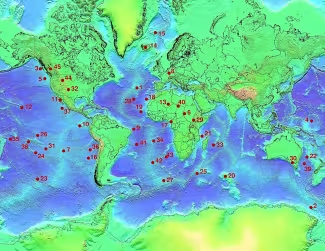
A team of scientists led by Georgia Tech have observed past episodic intraplate magmatism and corroborated the existence of a partial melt channel at the base of the Cocos Plate.

Jean Lynch-Stieglitz has earned a new fellowship with the National Academies of Sciences, Engineering, and Medicine to build STEM expertise in the State Department and the U.S. Agency for International Development.

The interdisciplinary Environmental Science (ENVS) degree program, developed by faculty in the Schools of Earth and Atmospheric Sciences and Biological Sciences, is now enrolling students interested in a wide variety of environment-related careers.

On July 1, SLS will launch the Center for Sustainable Communities Research and Education.
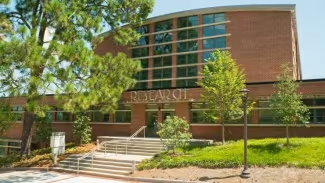
Newly announced AI Hub at Georgia Tech will unite AI entities across campus, enabling the Institute to align on goals to become an international thought leader in AI.
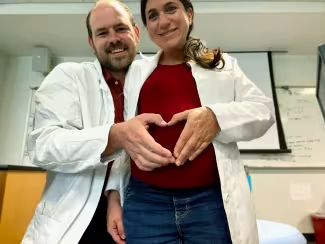
Christina Ragan has spent her career as a neuroscience researcher studying the neuroscience behind the mental health of motherhood. Now she’s set to begin a new research project — and become a parent herself.

Dominic receives a 2023 Merck Research Award for Underrepresented Chemists of Color, which provides him mentors and a chance to present work at an award symposium.
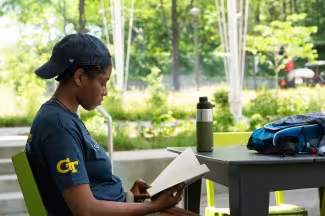
We asked a few avid readers for book recommendations.
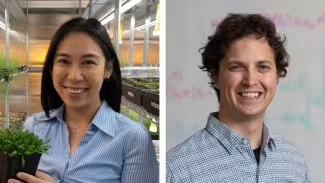
Awarded to Lily Cheung and Simon Sponberg, the grants will fund cutting-edge research in their fields.
Students will see no change in tuition and fees for the coming academic year.