

Wysocki’s research involves solving biomedical problems and developing new techniques and devices to study proteins in the human body.

Will Gutekunst, associate professor in the School of Chemistry and Biochemistry at Georgia Tech, co-leads the interface of polymer science and wood-based materials initiative along with Blair Brettmann at the Renewable Bioproducts Institute (RBI).
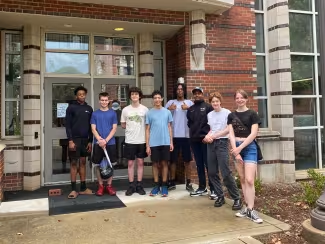
The Eighth Street West address will be new, but Explore’s mission to provide a science-focused hub where students thrive through academic support, career exploration, and engaging social activities remains unchanged.
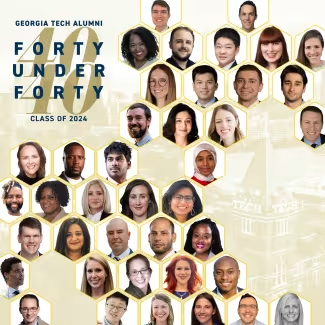
Four College of Sciences alumni have been selected as members of the 2024 class of 40 under 40.

Nine early-career professors will pursue cutting-edge climate mitigation research during the upcoming year as part of the initiative.

Berry, a Chemistry Ph.D. student, is one of 40 students in the U.S. to receive the Department of Energy Computational Science Graduate Fellowship awarded to emerging leaders in computational science.
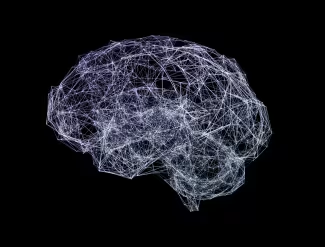
The science of human decision-making is only just being applied to machine learning, but developing a neural network even closer to the actual human brain may make it more reliable.
This science of human decision-making is only just being applied to machine learning, but developing a neural network even closer to the actual human brain may make it more reliable, according to the researchers.

Sherrill holds joint appointments with the School of Chemistry and Biochemistry and the School of Computational Science and Engineering. He also serves as associate director of the Institute for Data Engineering Science.
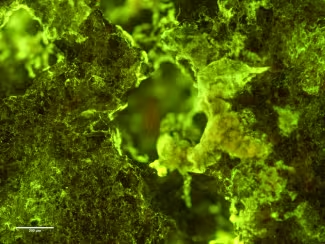
Up to 80% of infections in human bodies can be attributed to the bacteria growing in biofilms, and understanding how biofilms grow could lead to critical insights on controlling them.