
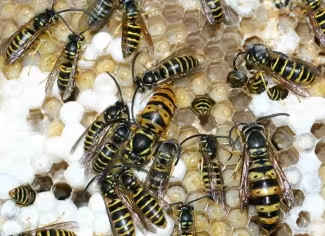
A Georgia Tech professor and his team are cracking the code on the Institute's most recognizable social insect.

The Fellowship will support the Freeman lab as it The Freeman lab investigates how mountain biodiversity persists in a warming world.
The seed grant program is administered by BBISS in collaboration with RBI, SEI, and IPaT.
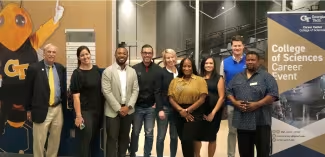
From navigating unexpected job pathways to the importance of networking and soft skills, College of Sciences alumni shared insights and advice about leveraging a Georgia Tech education into a successful career at the What Can I Do With My Georgia Tech Sci

Dean and Betsy Middleton and John Clark Sutherland Chair Susan Lozier has been reappointed to a five-year term in the College of Sciences.
The College of Sciences proudly recognizes the five graduate scholars awarded O’Hara Fellowships for the 2024-25 school year.

We hope that initiative leads will act as the “faculty face” of IRIM and communicate IRIM’s vision and activities to audiences both within and outside of Georgia Tech.
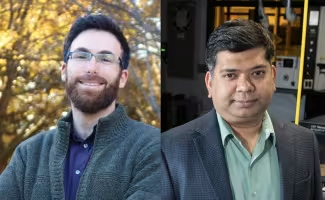
Itamar Kimchi and Sourabh Saha each received $875,000 for their pioneering work in quantum materials and fusion energy.

SoM hosts Peter Sarnak to give Fall 2024 Stelson Lecture.
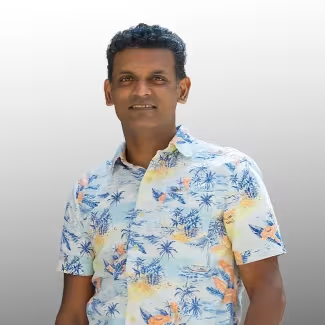
School of Mathematics Adjunct Professor Santosh Vempala and Georgia Tech alumnus Ben Cousins (Ph.D. ACO 2017) were honored for their method of estimating the volume of a convex body.