
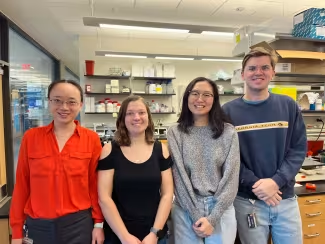
Han will investigate whether blocking specific neurons can help inhibit asthma — which may provide a new avenue for developing treatments.
Georgia Tech has earned a STARS Gold Rating in recognition of its sustainability achievements from the Association for the Advancement of Sustainability in Higher Education (AASHE).

This fall, the College of Sciences will debut three new minors, a new Ph.D. program, and a new “4+1” B.S./M.S. degree program.
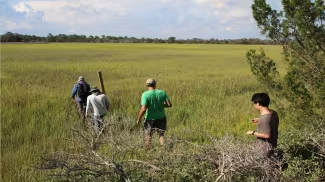
Understanding how salt marsh grass stays healthy is of crucial ecological importance, and studying the ways bacteria interact with these plants is key.
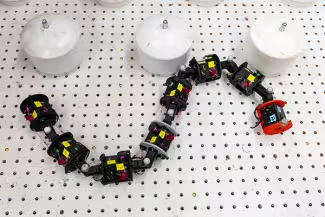
Worms and snakes seem to wiggle their way across varying environments without needing to learn the terrain. In more complex landscapes, they move even faster, using obstacles to propel themselves forward like a person pulling themselves up a ladder.

The College of Sciences is pleased to announce the appointment of Jean Lynch-Stieglitz as chair of the School of Earth and Atmospheric Sciences, effective September 2024.
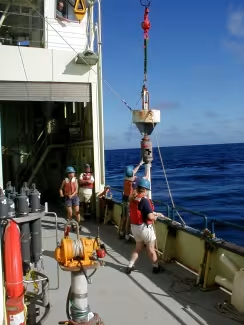
The study, lead by researchers at Georgia Tech, uncovers how weakening prehistoric ocean currents impacted North Atlantic nutrient levels and ocean life, supporting predictions about how today's oceans might react to a changing climate.

Gregory Sawicki and Aaron Young will use artificial intelligence to personalize exoskeleton assistance for people with symptoms resulting from stroke.

Growing the careers of research faculty at Georgia Tech is an integral part of Research Next, the strategic plan for the Institute’s research enterprise.
Georgia Tech researcher investigates how rainfall will change as Earth’s atmosphere heats up.