

A new study co-led by Anna (Anya) Ivanova highlights how human neuroscience is paving the way for AI innovation — and what AI can teach us about ourselves.
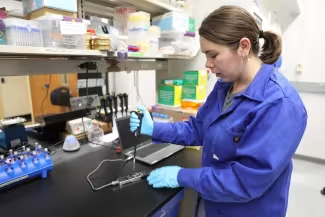
Georgia Tech researchers are teaming up with NASA to study bacteria on the International Space Station to help define how scientists and healthcare professionals combat antibiotic-resistant bacteria for long-duration space missions.

More than 30 College of Sciences faculty across all six schools and the Undergraduate Program in Neuroscience are recognized by the Institute for their excellence in research and teaching.

Charles Hong, Sandip Das, and Ryan Wiebold will travel to Canada this summer to advance their research projects in top-tier research facilities.

Physics professor honored for pioneering ultrashort-laser-pulse measurement techniques

Winner Lilypad Health disrupts invasive healthcare practices with an accessible alternative.
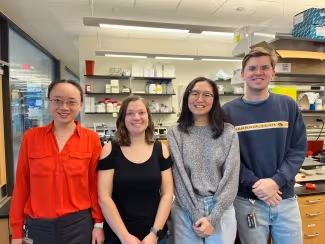
The School of Biological Sciences associate professor will be digging deep into itch-sensing neural circuits to gain insights into how the sensory system is wired — and where best to treat it when things go wrong.
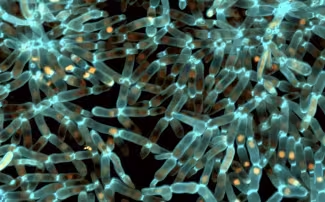
Researchers at Georgia Tech and University of Helsinki have discovered a mechanism steering the evolution of multicellular life. They identified how altered protein folding drives multicellular evolution.
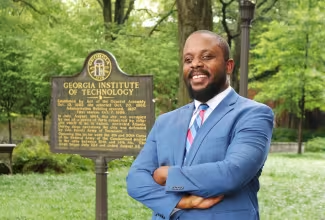
Wheaton is among five Georgia Tech faculty members selected for the 2024 ACC Academic Leaders Network (ACC ALN) Fellows program.

Co-PI Simon Sponberg will lead the Georgia Tech contingent of researchers, which aims to understand dynamic, agile movement.