

The award will support Kostka’s research on the role of marine plant microbiomes in coastal climate resilience in collaboration with Germany’s Max Planck Institute.
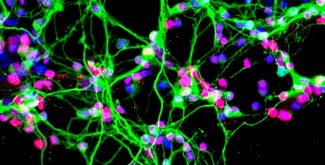
Researchers at Georgia Tech have developed an algorithm that helps AI models develop internal organization just like the human brain — boosting efficiency by 20 percent.
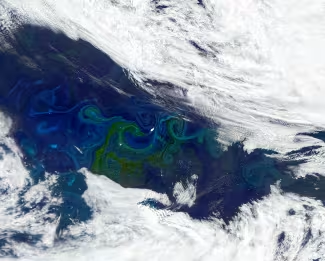
Ocean waters are getting greener at the poles and bluer toward the equator, according to an analysis of satellite data published in Science on June 19.

Insights could not only pave the way for new treatment strategies for genetic disorders, cancer and neurodegenerative diseases, but also enhance gene-editing technologies.
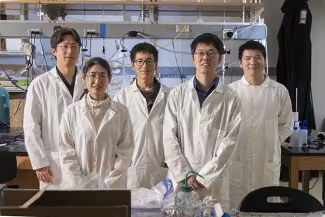
Georgia Tech researchers are innovating ways to study air quality — beginning with prehistoric insights and zooming all the way to satellites in our orbit.

Eighteen faculty members from the College of Sciences have been recognized by their students for outstanding teaching and educational impact.

As temperatures rise, proper hydration and heat acclimatization can help maintain physical and mental health. School of Biological Sciences Professor Mindy Millard-Stafford and Adjunct Professor Mike Sawka share best practices and strategies.
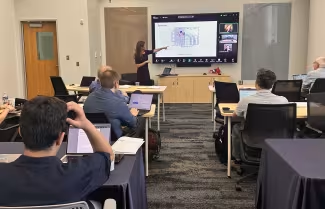
A bold space mission led by Georgia Tech and NASA aims to capture the most detailed images of black holes yet by launching twin telescopes into orbit.

A School of Physics alumnus has broken the world record for the most muscle-ups in 24 hours.
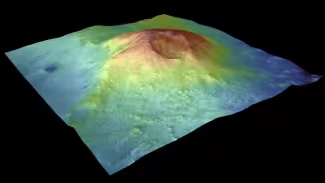
Georgia Tech scientists have uncovered evidence that a mountain on the rim of Jezero Crater — where NASA’s Perseverance Rover is currently collecting samples for possible return to Earth — is likely a volcano.