

Georgia Tech researchers analyze seasonal differences of SO₂ and sulfate concentrations in the atmosphere over decades to determine the long-term impact of sustained air quality control efforts.
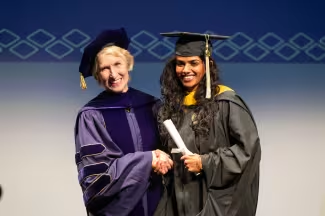
Sciences is the first Georgia Tech College to reach its target, exceeding a $75 million campaign goal.

Georgia Tech continues its upward trajectory in the latest U.S. News & World Report Best Colleges 2026 rankings. Among top public national universities, Georgia Tech held steady at No. 9, and it achieved No. 1 rankings across several categories.

The award recognizes outstanding scientists conducting field research that both explores the natural world and leverages collaboration.

Wang has been awarded a NASA Space Technology Graduate Research Opportunity to develop mathematically grounded solutions for landing spacecraft.
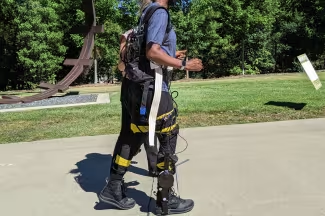
Three Georgia Tech researchers have received a $3.2 million Research Project Grant (R01) from the National Institutes of Health's (NIH) National Institute on Aging (NIA).
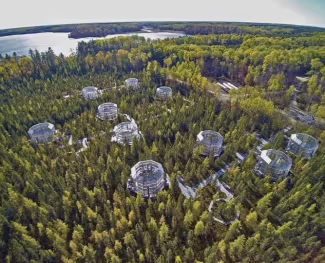
A new study is unearthing how and why peatlands are producing carbon dioxide and methane.
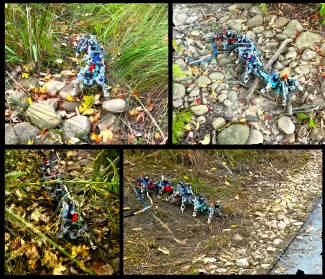
Dual publications highlight advances in multilegged robot motion

Jun Ueda receives NSF grant to research a critical gap in networked robotic systems

Nexus is Georgia Tech’s next-generation supercomputer, replacing the HIVE.